Education
Downloadable Drum Sheet Music PDFs That Help
Jun
You do not need another vague drum tab that gets the groove half right and the fill completely wrong. If you are learning a song for a gig, teaching it to a student, or trying to understand why a part works, downloadable drum sheet music PDFs are the practical answer. They give you a clean, portable format and, when the transcription is done properly, a reliable map of the actual drum part.
For serious drummers, the value is not just convenience. It is accuracy. A PDF you can download in seconds matters because it shortens the distance between hearing a part and playing it correctly. That matters even more when the song is detail-heavy, tempo-sensitive, or built around signature sticking, ghost notes, orchestrations, and dynamics that free tabs usually miss.
Why downloadable drum sheet music PDFs matter
A good transcription saves time, but more than that, it protects your practice time from bad information. If you have ever learned a verse groove from a random tab and then had to unlearn it later, you already know the cost of inaccuracy. The wrong kick placement, an omitted hi-hat opening, or a simplified fill can change the entire feel of a song.
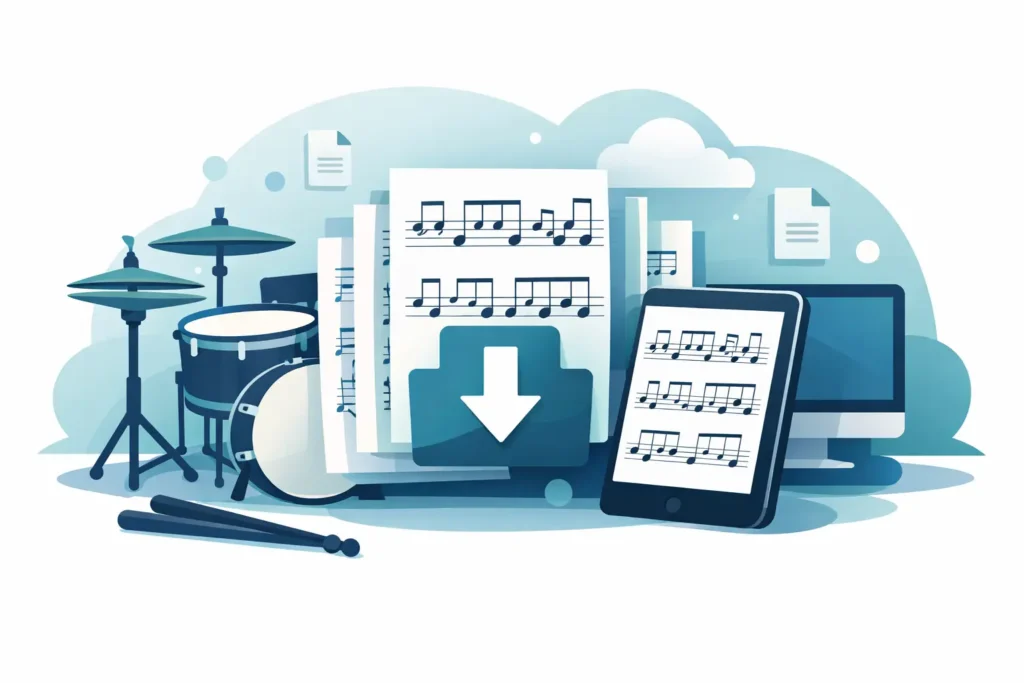
Downloadable drum sheet music PDFs solve a very specific problem. They give drummers direct access to song-based notation without waiting for shipping, printing a low-quality screenshot, or piecing together parts from multiple websites. You buy the chart, download it, and start working immediately.
That speed matters in real use. A cover-band drummer might need to prep three songs before rehearsal. A teacher may need a readable transcription for a lesson that afternoon. A student may finally want to understand what is actually happening in a Tool or Rush arrangement instead of guessing at it from memory.
What separates a useful PDF from a bad one
Not every drum PDF is worth using. The format alone is not the advantage. The quality of the transcription is.
A useful chart is note-for-note accurate, clearly engraved, and easy to follow at the kit. It reflects the real arrangement instead of a simplified version. It includes the details that define the part, not just the broad outline. That means rests are in the right place, dynamics make musical sense, repeats are handled clearly, and the page layout supports actual practice instead of creating visual clutter.
This is where a lot of free material falls apart. Some tabs are really just memory-based approximations. Others flatten the song into generic rock notation and ignore the character of the performance. That may be enough for a beginner trying to get through a chorus, but it is not enough for drummers who want to play the song the way listeners recognize it.
There is also a difference between readable and technically complete. A chart can contain the right notes and still be frustrating if it is poorly spaced or inconsistent in notation. Good downloadable drum sheet music PDFs should feel dependable on the stand, not like something you need to decode.
Who gets the most value from downloadable drum sheet music PDFs
Intermediate and advanced drummers usually benefit the most because they can turn notation into results quickly. They are often learning specific songs, not just general styles, and they care about the details that make those songs work.
Teachers also get strong value from accurate PDFs. A student learns faster when the material is clear and trustworthy. Instead of spending lesson time correcting internet tabs, the teacher can focus on timing, technique, phrasing, and interpretation.
Gigging drummers are another obvious fit. If you are adding Foo Fighters, Queen, or Taylor Swift to a set list, speed matters. So does consistency. A clean PDF gives you something you can practice from, mark up, print, and revisit before the show.
Even advanced players who can transcribe by ear often use written charts because it is more efficient. Ear training is essential, but not every practice session needs to start from zero. Sometimes the smart move is to use an accurate chart and spend your energy on execution.
When exact transcription matters most
There are songs where a rough chart is enough, and there are songs where it absolutely is not. Straight-ahead pop or simple rock grooves can sometimes survive minor simplification. Progressive rock, technical metal, funk, and arrangement-heavy material usually cannot.
If you are working on Dream Theater, Tool, Rush, or System Of A Down, exact notation becomes much more valuable. Those songs are often built around specific orchestrations, meter changes, and recurring rhythmic ideas. Missing one phrase can make the next section harder to understand.
The same is true in a different way for artists whose drumming is more about feel and touch. A Red Hot Chili Peppers groove, a Radiohead texture, or a Led Zeppelin part may not always look dense on paper, but the details still matter. The placement of ghost notes, the length of a crash pattern, or the shape of a transition fill can be the difference between sounding informed and sounding generic.
How to choose the right drum PDF for your needs
Start with your purpose. If you need the song for performance, accuracy comes first. You need the chart to reflect the original part closely enough that you can trust it under pressure. If you are using it for teaching, readability and structure matter just as much because the page has to support explanation.
Next, consider the song itself. Dense arrangements require more careful notation. If you are buying a chart for a technically demanding artist, you should expect precision, not a stripped-down summary. A catalog with strong coverage across artists like Metallica, Muse, Slipknot, Gojira, and Twenty One Pilots is more useful than a general site with scattered titles and inconsistent standards.
It also helps to look for breadth within artists. Drummers rarely learn one song and stop there. If you are studying a band deeply, artist-based browsing is practical. It lets you move from one chart to the next without switching sources or wondering whether the notation style will suddenly change.
Downloadable drum sheet music PDFs in real practice
The best PDFs fit naturally into how drummers actually work. You can print them for the music stand, keep them on a tablet for rehearsal, or annotate them during slow practice. Circle trouble spots. Mark sticking choices. Add reminders for transitions and tempo changes. Because the file is already organized, you spend less time preparing materials and more time playing.
This also makes song study more focused. Instead of learning only the obvious sections, you can isolate the details that usually get skipped – pre-chorus build patterns, short turnaround fills, cymbal phrasing, or subtle variations between repeated verses. Those are often the things that separate a convincing performance from a passable one.
There is a long-term benefit too. A personal library of accurate PDFs becomes a working repertoire resource. Teachers can reuse charts with multiple students. Performers can revisit songs months later without having to relearn them from scratch. Serious hobbyists can track progress across styles and artists with less friction.
Why drummers keep coming back to accurate catalogs
A focused catalog matters because drummers usually search by song or artist, not by abstract category. They want the chart for the track they are learning now. Then they want the next one. That is why a specialized store built around note-for-note song transcriptions is more useful than a broad music site that treats drum notation like an afterthought.
The strongest catalogs also reflect how broad modern drumming study has become. One player might move from AC/DC to Bruno Mars, then from Soundgarden to Hozier, then spend a week breaking down Tool or Muse. Genre range is not a bonus feature. It is part of being useful.
That is where The Drum Sheet Music Store fits the job well. A catalog that covers classic rock, metal, pop, funk, jazz, and modern alternative gives drummers a place to work across real set lists and real listening habits without sacrificing transcription accuracy.
The trade-off: convenience only works if the chart is right
Digital access is a clear advantage, but convenience on its own is not enough. A fast download of a weak chart still wastes your time. The real value of downloadable drum sheet music PDFs is the combination of speed, readability, and note-for-note reliability.
That is the standard worth paying for. Not because every drummer cannot learn by ear, but because accurate written material makes targeted practice more efficient. It helps you hear more, understand more, and play with more confidence.
If a song matters enough to learn, it is worth learning from a chart you can trust.
Buy 2 songs, get a 3rd free
Mix & match any songs from this list (or the whole store) – the cheapest one is free, applied automatically in your cart.


