Education
How to Use Drum Sheet Music Correctly
May
Most drummers hit the same wall at some point. You download a chart, put it on the stand, count in, and realize that knowing how to use drum sheet music is not the same as just owning it. The page gives you the part, but only if you know what to look for, what to ignore at first, and how to turn notation into muscle memory.
If your goal is to learn songs accurately, save practice time, and stop guessing at details, drum sheet music is one of the most useful tools you can put in front of the kit. But it works best when you treat it as a practice system, not just a reference page.
How to use drum sheet music from the first read
Start by scanning the full chart before you play a note. Look at the tempo, time signature, repeats, codas, section labels, and any obvious dynamic markings. Then look for the shape of the arrangement. Verse, chorus, bridge, stop-time section, build, ending – that structure matters as much as the individual notes.
A lot of drummers make the mistake of reading left to right and trying to perform the page immediately. That usually creates hesitation, dropped fills, and bad time. A better approach is to get the map first. Once you know where the big changes happen, the notation becomes easier to process in real time.
Next, identify the core groove patterns that repeat. Most song charts are not a nonstop stream of new information. They are usually built around a few recurring beats, a handful of fills, and some transition figures. If you can isolate those repeated ideas early, the chart gets smaller fast.
Understand the layout before you chase details
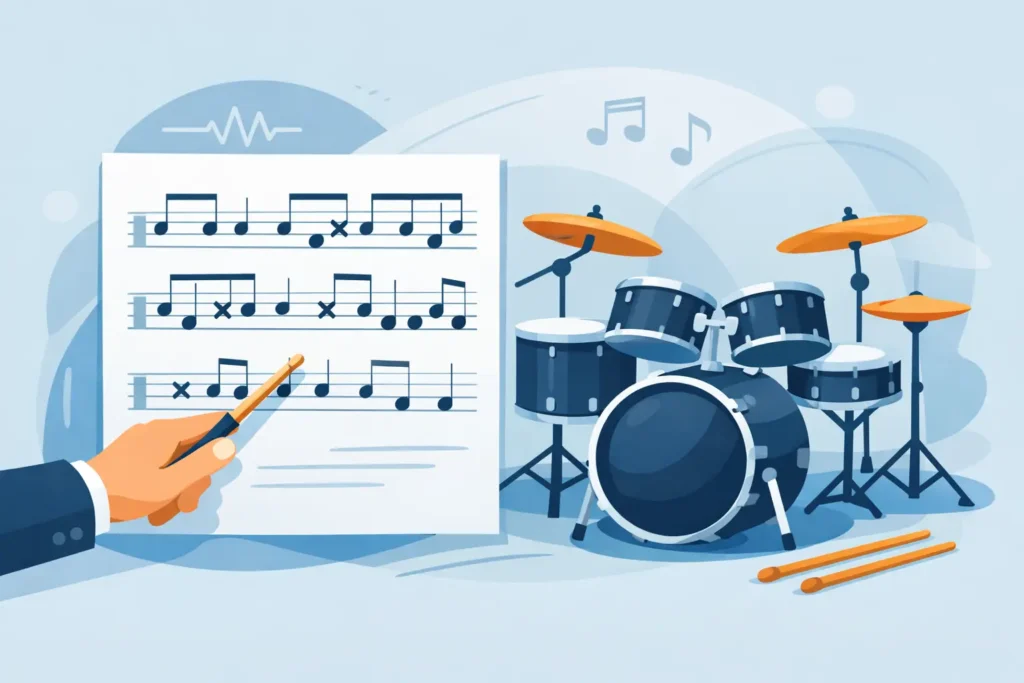
Drum notation is only useful if you know how the page is organized. On most charts, the hi-hat, ride, and crash cymbals sit higher on the staff, snare is centered, and kick sits lower. Tom placements vary slightly depending on the publisher, so always check the key if one is provided.
That last point matters more than many players think. There is no single universal placement system used by every transcriber. The general logic stays familiar, but ghost notes, cross-sticking, open hi-hats, accents, flams, and foot splashes can be marked in different ways. If you skip the legend and assume everything, you can learn the wrong part.
Rhythm reading matters just as much as drum placement. If a groove looks harder than it sounds, the issue is often rhythmic understanding rather than coordination. Count the subdivision away from the kit. Quarter notes, eighths, sixteenths, triplets, rests, ties – if you can say them, you can usually play them.
Read the rhythm, then orchestrate it
This is one of the simplest ways to reduce mistakes. First figure out when the notes happen. Then figure out where they happen on the kit. Trying to solve both problems at once slows everything down.
For example, a fill may look intimidating because it moves across snare and toms, but rhythmically it might just be straight sixteenth notes with an accent pattern. Once the timing is stable, the orchestration becomes much easier to place.
Use drum sheet music to learn songs faster
If you are learning a full song, do not try to memorize every bar in one pass. Break the chart into sections and assign a job to each section. Maybe the intro is about kicks with crashes, the verse is about consistency, and the chorus is about stronger dynamics and a specific fill into beat one.
Work in layers. First, play through with simplified motions while following the form. Then tighten the groove details. Then add articulations like accents, ghost notes, open hi-hats, and cymbal choices. This approach gets you to a playable version quickly without losing the note-for-note target.
The trade-off is speed versus precision. If you are prepping for a gig tomorrow, you may need to prioritize form and major hits first. If you are building the exact studio part for recording, the small details matter earlier. Good sheet music supports both situations, but your practice order should match the deadline.
Mark the page like a working drummer
A clean PDF is useful. A marked-up chart is better. Circle repeated problem spots. Draw brackets over sections. Write stickings if needed. Mark where the groove opens up or where the vocal cue lines up with a fill.
This is not cheating. It is practical reading. The goal is not to preserve the page in perfect condition. The goal is to make the chart easier to execute under pressure.
How to practice with a chart without becoming dependent on it
Some players worry that reading will make them less musical. Usually the opposite is true. Good reading removes guesswork, which leaves more attention for feel, sound, and consistency. The key is using the chart as a temporary support, not a permanent crutch.
Start by keeping the page visible for full run-throughs. Once the arrangement begins to stick, cover sections you already know and test your memory. Then use the chart only for trouble spots. Eventually, the page becomes a confirmation tool instead of a lifeline.
This matters a lot for cover-band drummers, teachers, and students. If you depend on the page for every measure, your eyes stay down and your time can get stiff. If you move away from the page too early, you can miss details and hardwire mistakes. The middle ground works best.
Common mistakes when using drum sheet music
The biggest mistake is treating all notes with equal importance. In real playing, not every note carries the same weight. Backbeats, kick placements, ensemble hits, and signature fills usually define the part. Small ghost-note details are critical too, but they come into focus more easily after the framework is solid.
Another common mistake is ignoring dynamics. A chart can show the right notes and still sound wrong if everything is played at one volume. Accents, ghost notes, crescendos, and cymbal balance are part of the transcription, not extra decoration.
Tempo is another trap. Many drummers practice difficult passages too fast because the original song feels familiar. Slow practice is not just for beginners. It is often the fastest route to a clean result, especially with intricate parts from bands like Tool, Dream Theater, Rush, or Gojira.
Accuracy beats approximation
Free tabs and casual charts often give you the rough idea of a song. That can be enough for a jam. It is usually not enough for serious learning, teaching, audition prep, or accurate performance.
That is where note-for-note transcription matters. If you are learning a part like Metallica, Queen, Foo Fighters, or Twenty One Pilots, the difference between a generic groove and the actual recorded part is the difference between sounding close and sounding right. Reliable notation shortens that gap.
Choose the right chart for your goal
Not every drummer needs the same level of detail every time. A beginner working on reading may want a straightforward song form with clear groove notation. An advanced player preparing for a tribute set may need every kick variation, ghost note, and exact fill placement.
That is why source quality matters. If the chart is inaccurate, you waste time practicing corrections instead of learning the song. If the layout is cluttered or inconsistent, reading becomes harder than it needs to be. Good drum sheet music should be readable, song-specific, and faithful to the performance.
If you regularly learn songs across styles, it also helps to work from a catalog that covers different playing vocabularies. Rock, metal, funk, pop, and progressive material each put different demands on reading and coordination. A precise chart lets you focus on the musical language instead of decoding errors.
How to use drum sheet music for long-term improvement
The best use of notation is not just learning one song. It is building stronger timing, better reading, cleaner phrasing, and a more accurate ear over time. When you compare what you hear to what you see and what you play, your internal understanding of groove gets sharper.
That is especially useful if you teach, perform regularly, or work through a lot of material. Over time, you start recognizing common phrase lengths, fill structures, recurring rhythmic figures, and stylistic choices. Reading becomes faster because your brain sees familiar patterns instead of isolated notes.
And that is the real payoff. Knowing how to use drum sheet music means you spend less time guessing and more time actually playing the part the way it was meant to be played. Put the page to work, trust accurate notation, and let the chart help you hear deeper than your first pass ever could.
Buy 2 songs, get a 3rd free
Mix & match any songs from this list (or the whole store) – the cheapest one is free, applied automatically in your cart.


