Education
Why Use Drum Slashes When Reading Music?
Sep
A chart lands on the stand five minutes before rehearsal. The verse has a written groove, the chorus has key crashes and kicks, and the eight-bar guitar solo is covered in diagonal marks. Knowing why use drum slashes is the difference between treating that space as missing information and using it to keep the song moving with confidence.
Drum slashes are a practical notation tool. They preserve the rhythmic structure and important cues of a part without forcing every bar of timekeeping onto the page. For drummers who read in rehearsals, teach students, or need to learn a set quickly, that balance matters. A good chart tells you what must be exact and leaves room for the musical decisions that belong to the player.
What Drum Slashes Mean in a Drum Part
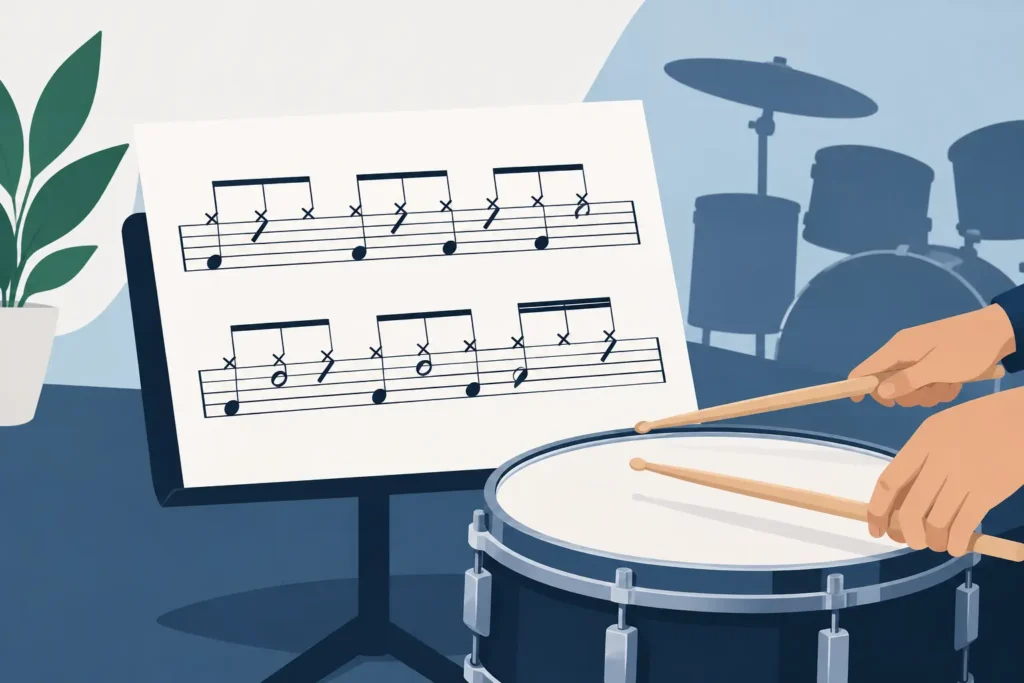
Slash notation uses diagonal slash marks on the staff to show that a rhythmic span should be played without spelling out every individual drum and cymbal note. In many charts, the slashes indicate that you should maintain the established feel, comp appropriately, or continue a groove until the next written figure.
They are often used after a groove has already been introduced in full notation. For example, a verse may show two detailed measures of a straight eighth-note rock beat, then switch to slashes for the next six measures. The arranger is not asking you to stop reading. The bar lines, rests, chord changes, lyrics, rehearsal marks, and any written accents still define the form. The slashes simply remove repeated visual information.
The exact convention can vary by publisher, bandleader, and style. A slash may represent a beat-level rhythmic framework, a general comping area, or a continuation of the previous pattern. That is why the surrounding notation matters more than any isolated symbol. Read the slashes in context: what was the last fully written groove, what instruments are carrying the section, and what figures are coming next?
Why Use Drum Slashes Instead of Writing Every Note?
The main reason is clarity. Fully notating sixteen bars of the same backbeat can make a page dense without making it more useful. The drummer already understands the core pattern after seeing it written clearly once. Replacing repetition with slashes makes the chart easier to scan, especially when a page also needs lyric cues, tempo changes, dynamics, stops, and ensemble hits.
Slashes also recognize that drums are not always a fixed sequence of identical notes. In a live performance, the correct hi-hat articulation, ghost-note density, cymbal choice, or fill into the next phrase may change with the room, the band, and the energy of the song. A notation approach that writes every note can imply a level of rigidity that the music does not need.
That does not mean slashes are a substitute for accuracy. They work best when the essential identity of the part has already been established. If a groove depends on a specific bass drum placement, unusual sticking pattern, signature tom phrase, or tightly arranged cymbal part, it should be written. A slash is useful when the player can make an informed choice without losing the song.
Slashes Keep the Form Visible
Drummers often have to navigate a song more than they have to decode a beat. A well-laid-out chart lets you see that the pre-chorus is four bars, the chorus expands to eight, and the break lands on the final beat before the next section. Reducing repetitive notation helps those structural landmarks stand out.
This is especially valuable on a first run-through. Instead of tracking a crowded stream of repeated hi-hat and snare notes, you can watch for the written crash on beat one, the two-beat stop, or the cue that signals a change from closed hats to a ride pattern. The chart becomes a road map rather than a transcription of every hand motion.
Slashes Leave Space for Musical Judgment
A drummer may play the same basic groove differently under a quiet vocal line than under a guitar solo. Slashes can invite that judgment while keeping the rhythm section locked to the arrangement. You might thin out the pattern, open the hats at phrase endings, add a small pickup, or avoid a fill because the vocalist is still finishing a line.
For jazz, funk, theater work, worship settings, and many cover-band charts, this flexibility is part of the job. The written material identifies the pulse and the arrangement. Your ears determine the appropriate texture.
How to Read Drum Slashes Correctly
Start with the nearest detailed notation. If the previous measure shows a half-time groove, slashes are usually asking you to continue that half-time feel. If the song has shifted to a ride-cymbal chorus pattern, do not automatically return to the verse beat just because the notation becomes less specific.
Next, count the measures and protect the phrase. Slashes are not permission to drift. Keep track of the number of bars, listen for harmonic or vocal changes, and identify the next written entrance before you reach it. If a four-bar slash passage ends with a written ensemble hit, the quality of your time through those four bars determines whether the hit feels convincing.
Then look for added notation around the slashes. Dynamics, text directions, accents, rhythmic figures, repeat endings, and cues may all modify what you play. A written accent above a slash measure matters. So does a marking such as cresc., simile, fill, or play time. The slashes provide the broad framework; the additional markings supply the instruction.
It is also wise to ask a bandleader what they expect when the chart is unfamiliar. In one setting, “slashes” means play the established groove with small variations. In another, it means light timekeeping under a solo. A ten-second clarification is better than guessing during a take.
Drum Slashes vs. Repeat Symbols and Fully Written Parts
Drum slashes are related to, but different from, repeat symbols. A repeat-measure symbol generally tells you to repeat the previous measure or measures as written. Slash notation is broader. It may suggest continuing the feel, but it does not always require an exact copy of every note.
That distinction matters in performance. If a groove is iconic and must match the recording, an exact repeat indication or fully written part is safer. If the musical role is simply to support a repeated chord progression, slashes may be the cleaner and more appropriate choice.
Fully written drum notation has its own strengths. It is the right choice for a note-for-note transcription, a complex orchestration, a difficult syncopated pattern, or any passage where specific details define the song. Think of the tightly constructed parts associated with Tool, Rush, Dream Theater, or many progressive metal arrangements. In those situations, a small change in orchestration can change the entire phrase.
For song learning, this is why the source of the chart matters. A reliable transcription should write the signature material precisely while using shorthand only where it genuinely improves readability. The goal is not fewer notes on paper. The goal is the right information on paper.
When Slashes Can Cause Problems
Slash notation becomes risky when it appears before a groove has been made clear. A drummer cannot accurately continue an idea that has never been defined. It can also create problems when an arrangement has subtle changes from bar to bar, such as a displaced kick, an alternating cymbal bell pattern, or a fill that sets up a vocal entrance.
Less experienced readers may also interpret slashes as “play anything.” That approach can lead to overplaying. The musical question is not what you can add. It is what the song needs while the notation leaves the choice to you. If the verse is built around space, a busier pattern is not more professional simply because the chart gave you freedom.
For teachers, slashes are useful once students can hold form, hear phrase lengths, and sustain a groove independently. Before that point, fully notated exercises can reveal whether the student understands subdivision, coordination, and dynamics. Afterward, slash passages are an effective way to develop real-world chart reading.
A Better Way to Practice Slash Notation
Take a familiar song and write out one or two measures of its primary groove. Then mark the next four or eight measures with slashes. Play through the section while counting aloud, keeping the pulse consistent and landing on a written crash or fill at the end. Record yourself and listen for whether the groove stays settled when the notes disappear from the page.
Repeat the exercise with one rule changed: keep the same groove, but vary only the cymbal texture or add one restrained fill at the end of a four-bar phrase. This teaches the central skill behind slash notation: maintaining the song’s identity while making controlled musical choices.
The best use of drum slashes is efficient, not vague. Read the form, respect every cue, establish the groove before you vary it, and let the arrangement tell you how much freedom the space can handle.


