Education
Sheet Music vs Learning by Ear for Drummers
Sep
A drummer learning a cover for Friday night does not need a debate about philosophy. They need to know where the crash lands, whether the chorus groove changes, and what happens in the four bars before the guitar solo. Sheet music vs learning by ear is not a choice between a “real” musician and a reader. For most working drummers, it is a question of accuracy, speed, and what the song demands.
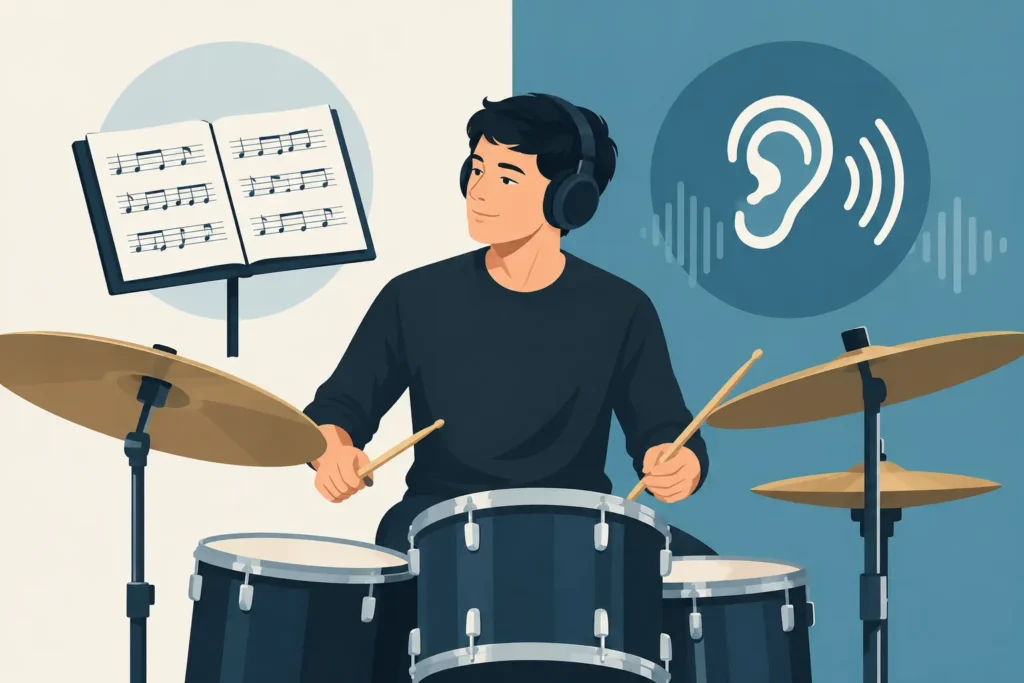
Learning by ear develops musical instincts that no page can supply. Accurate drum notation preserves the details that are easy to miss when a dense mix, a short deadline, or an unfamiliar arrangement gets in the way. The strongest approach usually uses both.
Sheet Music vs Learning by Ear: The Real Difference
Learning by ear means listening closely, identifying the song form, and working out the groove, fills, dynamics, and transitions through repetition. It trains recognition. You start hearing the difference between an eighth-note ride pattern and a slightly open hi-hat, or between a fill that begins on beat four and one that starts a beat earlier.
Sheet music turns those decisions into a readable record. A quality transcription gives you bar counts, repeat structures, rhythmic placement, orchestration, and often the subtle sticking or cymbal choices that define a part. It is especially useful when a song has layered sections, odd groupings, or fills that fly past before you can isolate them.
Neither method automatically makes a performance musical. A drummer can read every note and still play stiffly. Another can learn an entire song by ear and still miss a crucial kick pattern that makes the groove feel right. The goal is not to choose a side. It is to get the part under your hands accurately enough that you can perform it with confidence.
What Learning by Ear Does Better
Ear training forces you to hear the song as a complete piece of music rather than a series of written instructions. That matters when you need to react to a vocalist extending a chorus, a guitarist taking an extra solo pass, or a bandleader calling a different ending during rehearsal.
It also builds internal time. When you learn a groove from listening, you absorb the pulse, phrasing, and energy of the recording. This is particularly valuable in styles where the written rhythm can look straightforward while the feel is not. A laid-back pocket, a pushed chorus, or a ghost-note pattern may require listening long after you understand the notation.
For simple songs, learning by ear can be the fastest option. If the form is clear, the beat is consistent, and the fills are not signature moments, a focused drummer may have the framework in a few listens. This is common in basic rock, pop, and blues settings where supporting the band matters more than reproducing every recorded detail.
The limitation is that your ear can fill gaps with assumptions. You may hear the broad groove correctly but miss that the kick anticipates beat three, the snare is displaced in the pre-chorus, or the drummer changes the bell pattern only on the final repeat. Those details often separate a passable cover from a recognizable one.
When Drum Sheet Music Saves Time
Notation earns its place when the part contains information that is difficult to retain or verify by listening alone. Complex forms, tempo changes, metric modulation, unusual cymbal orchestrations, and fast fills all become more manageable when they are written clearly.
Think about progressive rock and metal parts where one section may shift between meters while the main riff continues. Songs associated with Tool, Dream Theater, Rush, and Animals As Leaders can demand serious listening skills, but a precise chart prevents the player from repeatedly guessing at the same passage. Instead of spending an hour deciding whether a phrase is five beats, seven beats, or a displaced four-bar idea, you can see the structure and practice it deliberately.
Accurate notation is equally useful outside technically demanding genres. A funk groove may depend on one quiet ghost note. A pop arrangement may rely on a programmed-sounding kick placement. A classic rock part may include a signature fill everyone in the room expects to hear exactly. The notes are not difficult because they are fast. They are difficult because they are specific.
For a drummer preparing multiple songs, sheet music also reduces memory load. You can mark repeats, highlight cues, write sticking choices, and make a roadmap for the full set. That is a practical advantage for auditions, theater work, student recitals, worship gigs, and cover bands with limited rehearsal time.
The Problem With Inaccurate Charts
Not all drum music is equally useful. Simplified charts can identify the style of a song without capturing its actual drum part. Generic drum tabs may show a beat pattern but omit rests, dynamics, ghost notes, cymbal choices, and the exact length of fills. That can create false confidence: the part looks learned until it is played alongside the recording.
A note-for-note transcription should not remove the need to listen. It should give you a dependable reference point. If the chart says a crash occurs on the “and” of four, listen for why it works. If it shows a hi-hat opening in the second chorus only, hear how that choice lifts the arrangement. The page tells you what happens; the recording tells you how it feels.
This is where reliable song-specific notation is worth more than a rough outline. The Drum Sheet Music Store focuses on readable, note-for-note drum transcriptions so players can spend practice time playing rather than correcting questionable arrangements.
Use the Recording and the Page Together
The most efficient process starts with a full listen before you read a note. Map the song mentally: intro, verse, pre-chorus, chorus, bridge, solo, ending. Notice the large dynamic changes and the signature moments. This gives the notation context before you begin working measure by measure.
Next, read while listening. Follow the chart without playing at first, especially in sections that move quickly or repeat with small variations. Confirm where the notation matches what you hear. If a rhythm looks surprising, resist the urge to “fix” it immediately. Many parts that seem awkward on paper make perfect sense once you hear the guitar, bass, and vocal phrase around them.
Then practice in short sections with a metronome or slow playback. Start with the skeleton: pulse, backbeat, kick placement, and form. Add ghost notes, openings, accents, and fills only after the main groove feels stable. This keeps difficult details from disrupting your time.
Finally, remove your eyes from the page at intervals. Play the section from memory while listening for the musical cues that lead into the next change. That turns notation into usable performance knowledge rather than a crutch.
Read the details, hear the purpose
A chart may show every note, but drumming is more than hitting the correct surfaces. The same written crash can be a huge arrival, a quick color, or a restrained cue depending on the track. Listen for volume, decay, touch, and space. These choices are why a technically correct cover can still feel unlike the original.
Learn the form, not just the measures
Bar numbers are helpful, but songs are easier to recall through landmarks. Know that the tom fill enters after the second vocal line, that the half-time groove begins under the bridge, or that the final chorus adds an extra tag. Ear training makes these connections stronger and protects you when a live arrangement shifts.
Which Method Should You Start With?
Start by ear when the song is simple, you are developing your listening skills, or you need to learn the general arrangement quickly. Start with sheet music when accuracy is non-negotiable, the part is dense, or you have to prepare several songs under pressure.
For intermediate players, a useful test is this: can you explain exactly what you are hearing? If you can hear the kick pattern, count the phrase, identify the cymbal sound, and reproduce the fill consistently, you may not need a chart for that section. If you are rewinding the same two seconds repeatedly and still guessing, notation is likely the faster route.
Advanced drummers benefit from both methods as well. Reading difficult material strengthens rhythmic precision and expands vocabulary. Transcribing by ear strengthens independence, memory, and stylistic awareness. One skill checks the other.
Make Accuracy Serve the Music
Do not treat sheet music as a substitute for listening, and do not treat learning by ear as proof that written accuracy is unnecessary. A great drum part has structure, sound, and intent. You need the structure to stay organized, the sound to match the record, and the intent to make the performance feel alive.
When the next song gives you trouble, listen until you understand its shape, use accurate notation to settle the details, and return to the recording until the part sounds like music instead of an exercise.


