Uncategorized
How to Read Drum Sheet Music Fast
May
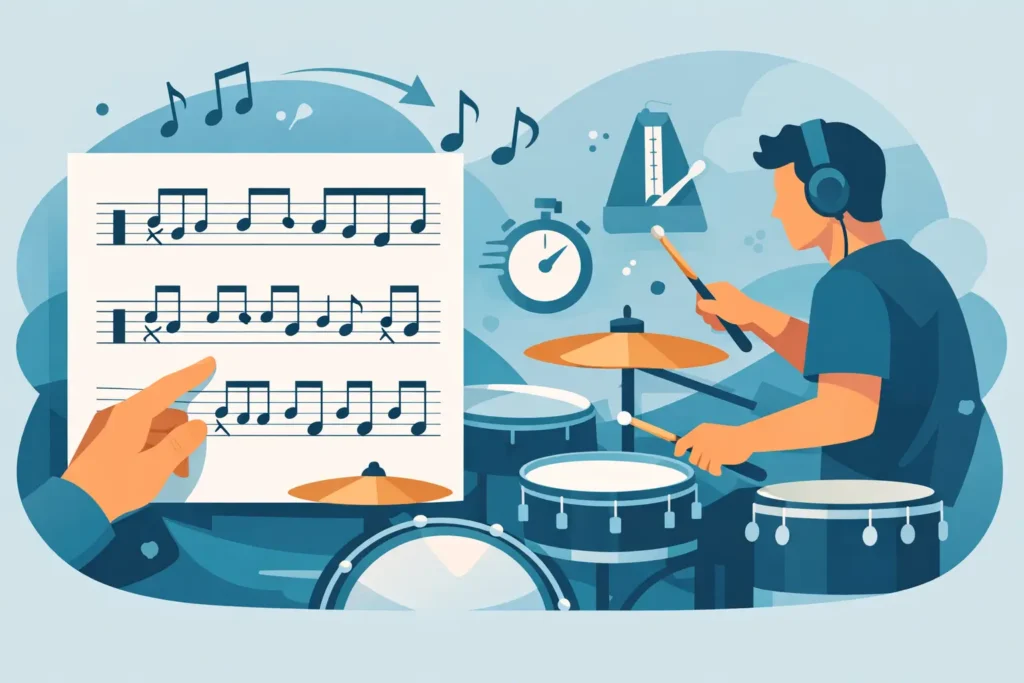
The first time you look at a full drum chart, it can feel crowded fast. Notes sit on different lines, stems point in different directions, and the page seems to assume you already know the system. The good news is that learning how to read drum sheet music is much more straightforward than most drummers expect once you understand what each part of the page is telling you.
Drum notation is not about pitch in the same way piano or guitar notation works. It is mainly about which surface you hit, when you hit it, and how the part is organized in time. Once that clicks, reading goes from confusing to practical.
How to read drum sheet music from the page layout
Start with the staff itself. Most drum music uses a five-line staff, but each line or space represents a part of the kit rather than a definite pitch. In a basic rock chart, the hi-hat is usually written with x-shaped noteheads near the top of the staff, the snare sits around the middle, and the bass drum appears lower down. Toms, ride, crash, and other cymbals are placed in their own standard areas.
There is some variation between publishers, books, and transcribers, so you should always check the drum key or legend when one is provided. That said, many charts follow common conventions closely enough that you will recognize the layout after reading a few pages.
The staff is also divided by bar lines. Each measure contains a specific number of beats based on the time signature. If the chart says 4/4, you are counting four quarter-note beats per measure. If it says 6/8, the feel and grouping change, even if the page still looks familiar at first glance.
Learn the drum key before anything else
If you skip the drum key, you make reading harder than it needs to be. A key tells you exactly which line or space matches each part of the kit. This matters because a floor tom in one chart may not appear in exactly the same position in another, and splash cymbals, china cymbals, bells, and auxiliary percussion can vary even more.
A reliable chart should make this mapping clear. On a song-specific transcription, that precision matters because the difference between a closed hi-hat, an open hi-hat, and a ride bell pattern changes the part in a meaningful way. If you are learning a recognizable groove or fill, reading the correct orchestration is just as important as counting the rhythm correctly.
Note values tell you when to play
Once you know what drum or cymbal each note represents, the next step is rhythm. This is where many drummers overcomplicate things. You do not need advanced theory to get started. You need to know how long notes last and how they fit inside the beat.
In 4/4 time, a quarter note gets one beat. An eighth note gets half a beat, so you count 1 and 2 and 3 and 4 and. A sixteenth note gets a quarter of a beat, so you count 1 e and a 2 e and a 3 e and a 4 e and a. Those subdivisions are the foundation of most grooves, fills, and accents you will see in popular music.
Rests matter too. If a note is not written, that silence is part of the groove. Tight reading means respecting space, not just hitting the right surfaces.
For many drummers, the fastest improvement comes from reading one line at a time. Ignore the whole beat for a moment and identify the hi-hat pattern first. Then place the snare backbeats. Then fit the kick drum underneath. Reading drums is often a layer-by-layer process, not a single instant scan.
Stems and noteheads help organize the groove
A lot of drum notation uses stem direction to separate limb functions. Cymbal patterns such as hi-hat or ride are often written with stems up, while snare and kick notes may appear with stems down or in a more compact grouping. This is not a strict rule in every chart, but it is common enough to help your eyes process the groove faster.
Notehead shape also gives you useful information. Standard oval noteheads are often used for drums, while x-shaped noteheads usually indicate cymbals or hi-hat. Open hi-hat markings may appear with a small circle above the note. Chokes, accents, ghost notes, flams, and drags all have their own symbols as well.
These markings are not decoration. They tell you how the part should sound. A ghost note on the snare is not the same as a full backbeat, and a crash with a choke has a completely different effect than a sustained cymbal hit.
How to count a basic groove on the page
If you want a practical way to start, use a simple rock groove. Imagine eighth notes on the hi-hat, snare on beats 2 and 4, and bass drum on beats 1 and 3. Written out, that is one of the easiest patterns to recognize and one of the most common.
Your hi-hat hand is playing steady notes across the bar. The snare lands in the middle of those repeating notes on 2 and 4. The bass drum anchors the pulse below. When you read the measure, train your eyes to see the vertical alignment. If hi-hat, snare, and kick line up at the same point on the staff, they happen at the same time.
That vertical reading is crucial. Drum notation is not read only left to right. It is also read top to bottom at each rhythmic moment.
Once that feels comfortable, move to sixteenth-note grooves, syncopated kick patterns, and openings in the hi-hat. At that point, the challenge is not understanding the notation system. It is tracking the timing cleanly enough to perform the groove accurately.
Reading fills without losing the count
Fills are where many drummers rush or lose their place. The notation usually is not the problem. The real issue is that players stop feeling the pulse once the groove breaks up across the toms.
The fix is simple but not always easy. Keep counting through the fill. If the measure contains sixteenth notes, count all the subdivisions, even when the sticking gets busy. Also pay attention to the orchestration. Two notes with the same rhythm can feel completely different depending on whether they move from snare to high tom or from floor tom to crash.
Good charts make this readable by placing toms in consistent positions and spacing the notes clearly. If you are working on a note-for-note song transcription, that layout becomes even more valuable because the exact movement around the kit is often part of the signature sound.
Dynamics and articulations are part of the part
If you only read the rhythms, you are only reading part of the music. Accents, ghost notes, crescendos, buzz rolls, cross-sticking, rimshots, and hi-hat foot splashes all affect the feel. In many songs, those details are what separate a passable version from an accurate one.
This is where lower-quality charts often fall short. They may show the basic beat but leave out the articulations that define the groove. Serious players notice that immediately. If you are reading to perform, teach, record, or prepare a cover set, those details are not optional.
How to practice reading drum notation efficiently
The best way to improve is to read real music every day, but keep the process controlled. Start slowly enough that you can identify the kit pieces and count the rhythm without guessing. Accuracy comes before speed.
Use a metronome and read one measure at a time if needed. Then connect two measures, then four, then a full section. If a groove keeps falling apart, isolate the rhythm first by clapping or tapping it, then orchestrate it on the kit. That extra step saves time because it separates counting problems from coordination problems.
It also helps to read music in styles you actually play. A drummer working on Metallica, Rush, Tool, or Dream Theater will run into different notation challenges than someone studying Adele, Taylor Swift, or Bruno Mars. The core reading system is the same, but the density, phrasing, and limb independence can change a lot.
Common mistakes when learning how to read drum sheet music
The biggest mistake is trying to memorize symbols without hearing the rhythm internally. Reading works better when you connect the page to sound right away. Another common issue is ignoring the legend and assuming every chart uses the same kit map. That is usually close enough for simple grooves, but it causes mistakes in detailed transcriptions.
Some drummers also focus only on the snare and kick while treating cymbal notation as background. That works until the chart includes specific openings, ride patterns, crash placements, or stack hits that shape the phrase. In real songs, those choices matter.
And of course, there is the temptation to use oversimplified tabs instead of proper notation. Tabs can be quick, but they usually do not carry the same rhythmic clarity, dynamic detail, or orchestration precision. If your goal is exact performance, standard drum notation gives you much more usable information.
Reading drum sheet music gets easier once you stop seeing the page as a wall of symbols and start seeing it as instructions for sound and motion. Learn the kit map, count the subdivisions, watch vertical alignment, and respect the details. After that, the page starts working for you instead of against you – and that is when accurate song transcriptions become one of the fastest ways to learn music the right way.
Buy 2 songs, get a 3rd free
Mix & match any songs from this list (or the whole store) – the cheapest one is free, applied automatically in your cart.


