Education
Best Rhythm Training App for Drummers?
Jun
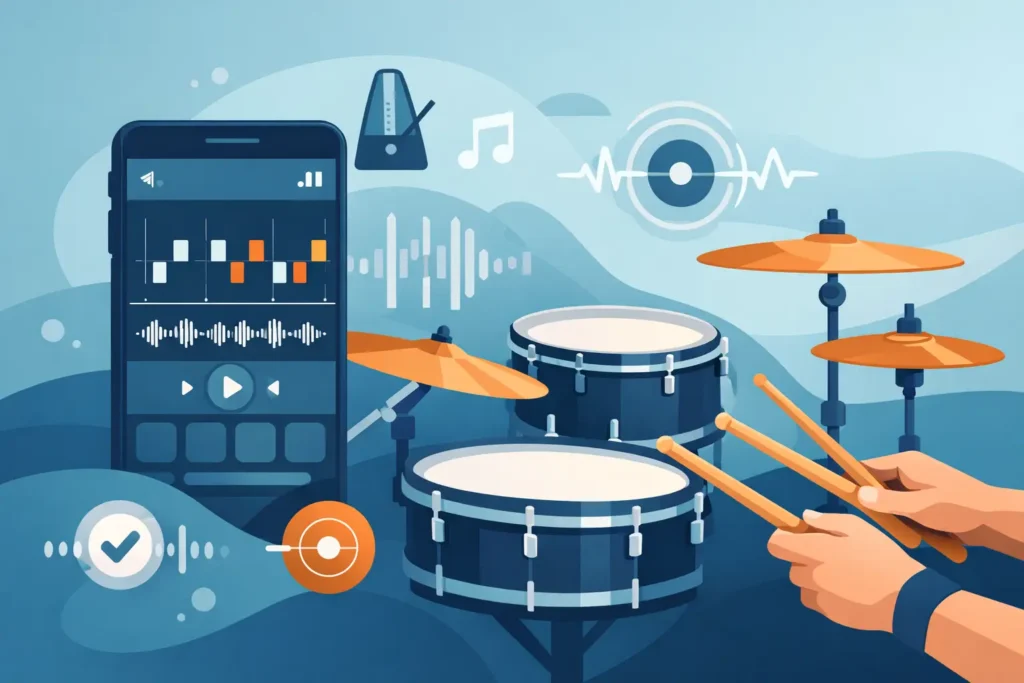
If your hands can play the part but the groove still feels shaky, the issue usually is not chops. It is time. A good rhythm training app for drummers helps expose small timing problems that a metronome alone can miss – rushed fills, dragged backbeats, uneven subdivisions, and weak internal pulse when the click drops out.
That matters whether you are learning a Tool chart, cleaning up a Foo Fighters groove, or trying to play a pop arrangement with consistent pocket from top to bottom. For most drummers, rhythm work gets vague fast. You know you need to improve timing, but not always what to practice, how to measure it, or how to make it connect to real songs. That is where an app can be useful, if it does more than just beep on quarter notes.
What a rhythm training app for drummers should actually do
The best app is not necessarily the one with the most features. It is the one that helps you hear, feel, and correct timing errors in a practical way. For drummers, that means the app has to train placement, subdivision, consistency, and recovery.
Placement is simple to describe and hard to master. Are your snare backbeats landing exactly where they should? Are your kick notes sitting evenly around the pulse, or are they creeping ahead? A useful app gives feedback on where your notes fall, not just whether you kept going.
Subdivision matters just as much. Plenty of players can hold quarter notes with a click, then lose control when the part shifts to 8th-note triplets, 16ths, or syncopated accents. If the app cannot train different subdivision layers, it has limited value for drummers who play rock, metal, funk, jazz, or modern pop.
Consistency is where practice usually breaks down. You may play one clean measure, then drift in the next four. Strong rhythm training exposes those habits over time. It shows whether your internal clock stays steady through repetitions, transitions, and fills.
Recovery is the final piece. Real music is not a lab test. If you rush a flam fill going into the chorus, can you re-center immediately without derailing the groove? A drummer-friendly app should train that skill too, especially with exercises that remove or thin out the click.
Why a standard metronome is not always enough
A metronome is still essential. It is fast, simple, and effective. But it does one job. It provides a reference pulse. It does not always tell you how far ahead or behind you are, which limb is causing the issue, or whether your subdivisions are unstable.
That is the gap a rhythm training app can fill. Instead of just keeping time for you, it can test your time. Some apps grade accuracy. Others mute beats or measures so you have to maintain pulse on your own. Some focus on reading and rhythmic recognition, which is especially useful if you are working from note-for-note charts and want cleaner execution on the page.
There is a trade-off, though. Too much visual feedback can make practice less musical. If you spend the whole session watching a screen tell you that you were 18 milliseconds early, you may improve precision while losing feel. Good rhythm practice still has to come back to listening, counting, and playing relaxed.
The features that matter most
If you are comparing options, start with exercises that target drumming problems directly. Gap click training is one of the most useful features. The click plays for a while, then drops out, forcing you to keep the pulse internal. When it returns, you find out quickly whether you stayed centered.
Subdivision control is another must-have. You want to practice quarter notes, 8ths, triplets, 16ths, and mixed rhythms without switching to a different tool every few minutes. If the app also lets you accent different parts of the beat, even better. That helps with groove placement and limb independence.
Scoring and tracking can help, but only if they are clear. A percentage score is useful when it shows progress over time. It is less useful when it turns practice into a game with no musical context. The same goes for visual grids. They can be excellent for identifying consistent rushing or dragging, especially on fills, but they should support your ear rather than replace it.
A practical rhythm trainer should also work well for short sessions. Most drummers are more consistent with ten focused minutes than with a vague promise to do forty-five. If the app makes it easy to open, select a subdivision, set a tempo, and start, you are more likely to use it.
How to use a rhythm training app without wasting practice time
The biggest mistake is treating the app as a separate world from your actual playing. Rhythm training works best when it connects directly to the material you are learning.
Start with a simple groove. Play quarter notes on hi-hat, snare on 2 and 4, kick on 1 and 3. If that does not sit well against the app, more advanced material will not either. Then move to 8th-note grooves, 16th-note kick patterns, and basic fills. Keep the sound quality clean and the dynamics controlled. Sloppy strokes create timing problems that are really technique problems.
Once the basics are stable, apply the same timing standard to song parts. If you are practicing a tight rock groove in the style of AC/DC or Green Day, focus on backbeat placement and steady 8ths. If you are working on something denser, like progressive metal or odd-meter material, use the app to isolate the subdivision framework before you play the full chart.
This is where exact notation helps. When you are reading a note-for-note transcription, you are not guessing what the drummer probably played. You are dealing with the actual rhythmic information. That makes rhythm practice more objective. You can take one measure, slow it down, and check whether your execution is accurate rather than just close enough.
If you are learning detailed parts from bands like Tool or Dream Theater, timing work is not optional. The cleaner your internal subdivision, the less mental energy you spend surviving the measure. You can focus on sound, phrasing, and transitions instead.
When an app helps most, and when it does not
A rhythm training app for drummers is most useful when you already know what you are trying to improve. If your issue is rushing fills, inconsistent triplets, weak click independence, or unreadable syncopation, the right app gives structure and immediate feedback.
It helps less if your real problem is technique, posture, or inconsistent sticking. Those issues can show up as bad time, but the fix may not be rhythmic. If your doubles are uneven because your hands are tense, no app will solve that by itself. The same goes for players who never practice with real music. Timing has to transfer to songs, not stay trapped in isolated drills.
There is also a skill-level question. Beginners can benefit from app-based rhythm work, but too much complexity too soon can be discouraging. Intermediate and advanced drummers usually get more value because they can diagnose problems faster and connect the exercises to actual repertoire.
A practical setup for song-based drummers
If your main goal is to learn songs accurately, keep the process simple. Use the app for ten to fifteen minutes before chart practice. Work on pulse, one subdivision, and one gap-click exercise. Then move straight into a transcription and apply the same focus.
For example, if a groove has tight 16th-note kick placement, train 16ths first. If the chart includes displaced snare accents or odd-meter figures, isolate that rhythmic shape in the app, then return to the written part. This kind of pairing is far more effective than generic timing drills with no musical destination.
That is also why tools and transcriptions work well together. A rhythm trainer sharpens your time. Accurate drum notation gives that improved time a real job to do. For drummers preparing songs for lessons, rehearsals, recording, or cover gigs, that combination is practical and efficient.
The Coryvo rhythm trainer is one example of this kind of focused practice tool. Used the right way, it is not there to replace your metronome, your ears, or your chart reading. It is there to show you where your time holds up and where it does not.
Choosing the right app for your goals
If you mostly play straight-ahead rock and pop, prioritize ease of use, gap click features, and subdivision control. If you work on dense notation, progressive material, or teaching, look for stronger reading support and more detailed feedback. If you get distracted by too much data, choose the simpler tool and stick with it.
The best rhythm training app for drummers is the one you will use consistently and connect to real music. Not the one with the longest feature list. Not the one that promises instant improvement. Just the one that helps you play steadier, hear better, and trust your time when the chart gets demanding.
Better timing is rarely dramatic while you are building it. Then one day the groove stops wobbling, the fill lands cleanly back on one, and the song feels easier than it used to. That is when you know the practice is working.
Buy 2 songs, get a 3rd free
Mix & match any songs from this list (or the whole store) – the cheapest one is free, applied automatically in your cart.


